
OSHA's Annual Violation Data Confirms Construction Sites Are Still Failing Workers in the Same Ways
The Numbers From FY 2025 Paint a Clear Picture of Where New York Jobsite Injuries Come From
Every year, the federal releases data on the workplace safety violations cited most frequently by its inspectors, and every year the list tells the same story. The hazards at the top haven't changed in well over a decade.
The violations keep piling up. And the workers who get hurt when those violations go unaddressed, on construction sites in New York City and across the country, are the ones left dealing with the consequences.
For injured workers trying to understand why they got hurt and who is responsible, that data matters, because it shows that what happened to them wasn't random. It was predictable and preventable.
The New York City construction accident lawyers at Pasternack Tilker Ziegler Walsh Stanton & Romano LLP have spent more than nine decades building cases around exactly that kind of evidence. Our firm has recovered billions for injured New York workers, and we understand what it takes to hold the right parties accountable when a jobsite failure costs a worker their health, their income, or their future.
Fall Protection Has Led the List for 15 Consecutive Years
For the 15th consecutive year, fall protection for construction topped OSHA's list of violations. In FY 2025, there were 5,914 violations under the general requirements for fall protection in construction, covering failures to provide guardrails, personal fall arrest systems, and covers over open holes and unprotected edges.
The fact that this category has held the top spot for a decade and a half without interruption isn't a coincidence. It reflects a persistent, industry-wide failure to treat fall hazards as the serious legal and moral obligation they are.
In New York, that failure carries an additional layer of legal significance. New York Labor Law Section 240, commonly known as the Scaffold Law, imposes absolute liability on property owners and general contractors for gravity-related injuries on construction sites, including falls from heights and injuries caused by falling objects.
That means a worker who falls from an unprotected edge because no fall arrest system was in place doesn't need to prove that the owner or contractor was negligent in the usual sense. The failure to provide legally required protection may be enough to establish liability under Section 240, depending on how the incident occurred.. It's one of the strongest worker protection laws in the country, and it exists precisely because violations like the ones OSHA keeps documenting continue to happen.
Ladders Are the 2nd Construction-Specific Violation on the List
OSHA cited 2,405 violations for ladder safety in construction in FY 2025, covering failures such as using the wrong type of ladder for the task, damaged equipment, improper securing, and workers standing on top steps or rungs not designed for that purpose. Ladders are among the most common pieces of equipment on any construction site, and that familiarity breeds a kind of complacency that regularly puts workers in the hospital.
Ladder accidents on New York construction sites are covered under both workers' compensation and, in many cases, under New York's Labor Law, depending on the circumstances of the fall and who was responsible for providing and maintaining the equipment. A worker hurt on a defective or improperly secured ladder may have claims against multiple parties, not just their direct employer.
Scaffolding Violations Grew in FY 2025
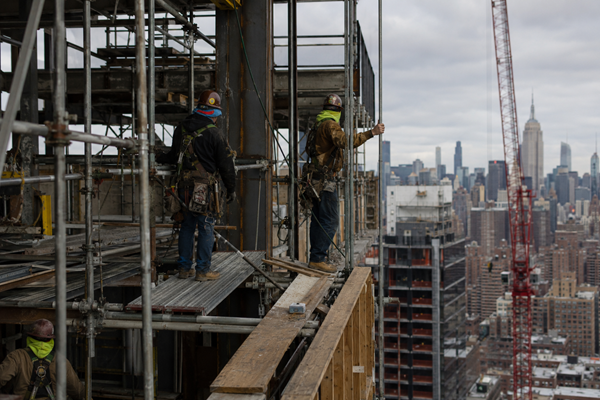
Scaffolding was the only violation category on OSHA's top 10 list that saw an increase in FY 2025, with 1,905 citations, 32 more than the prior year. OSHA inspectors found improperly constructed platforms, missing guardrails, and unsecured access points across a range of construction trades, including masonry, framing, siding, and roofing.
New York's scaffolding accident laws give injured workers particularly strong legal footing when a scaffold failure causes injury. Under Section 240 of the Labor Law, property owners and general contractors who fail to ensure that scaffolding is properly constructed and maintained can be held absolutely liable for the resulting injuries, regardless of whether the worker was also partially at fault.
Scaffolding injuries in New York City frequently involve multiple parties, multiple insurance carriers, and both workers' compensation and third-party liability claims running simultaneously, and having an attorney who understands how to pursue all available avenues of recovery is essential.
Fall Protection Training Is a Separate Violation, and It's Also on the List
OSHA cited 1,907 violations for fall protection training requirements in FY 2025, a category distinct from the physical fall protection violations at number one. This means that even on sites where some fall protection equipment exists, workers are not being adequately trained on how to recognize fall hazards, use the equipment correctly, or understand its limitations.
That training gap has real consequences in injury cases. When a worker falls and it can be established that they were never properly trained on the fall protection system they were supposed to be using, that failure of training becomes part of the evidence of negligence against the employer or contractor responsible for site safety.
It also reinforces that the injury wasn't simply an accident but a predictable outcome of a preventable failure.
Electrocution and Confined Space Hazards Round Out the Construction Picture
Beyond the headline categories, New York construction workers face serious risks from electrocution accidents, crane failures, trench collapses, and confined space incidents that don't always make the top 10 nationally but are a consistent source of catastrophic injuries on New York City jobsites.
Many of these incidents involve falling objects striking workers below, a hazard covered under Section 240, and one that OSHA's data shows is repeatedly tied back to failures in site organization and overhead protection.
How OSHA Violations Become Evidence In New York Construction Injury Cases
OSHA violations don't automatically determine liability in a lawsuit, but they often become powerful evidence in construction injury claims.
When a contractor, property owner, or subcontractor violates a known safety regulation, that violation helps establish that the hazard was foreseeable and preventable. Inspection reports, citations, training failures, and prior safety complaints can all become part of the evidence used to show how the incident happened and who failed to address the risk.
In New York construction cases involving Labor Law Sections 240 or 241(6), OSHA findings may also reinforce broader claims that proper site safety measures were missing long before the injury occurred.
When OSHA Violations Cause Injuries, Workers Have Legal Rights Beyond Workers' Compensation
Workers' compensation provides important baseline protection for anyone hurt on a New York construction site, covering medical expenses and a portion of lost wages regardless of fault. But for many construction workers, it's only part of the picture.
Workers' compensation and third-party claims can run concurrently, and the third-party claim, brought against a property owner, general contractor, or equipment manufacturer whose negligence contributed to the injury, is often where the most significant recovery comes from.
OSHA violations documented at the time of an injury, whether by an OSHA inspector or through a subsequent investigation, become important evidence in those third-party claims. They establish that the hazard was known, that there was a regulatory obligation to address it, and that the responsible party failed to meet that obligation.
An experienced New York construction accident attorney knows how to obtain and use that evidence, and how to coordinate the workers' compensation and personal injury sides of a case to maximize what an injured worker ultimately recovers.
Hurt on a New York Construction Site? We're Ready to Help.
Pasternack Tilker Ziegler Walsh Stanton & Romano LLP has been fighting for injured New York workers for over 90 years. If you were seriously hurt on a construction site anywhere in New York City, Long Island, the Hudson Valley, or across the state, we want to hear your story.
We handle cases on a contingency fee basis, meaning there are no upfront costs and you owe us nothing unless we recover compensation for you. Contact us today for a free consultation, available 24 hours a day, seven days a week.
"I highly recommend the Law Offices of Pasternack Tilker Ziegler Walsh Stanton & Romano LLP attorneys at law to anyone injured in a work-related accident seeking legal representation." - J. Cabrera, â�â�â�â�â�